
Blooming
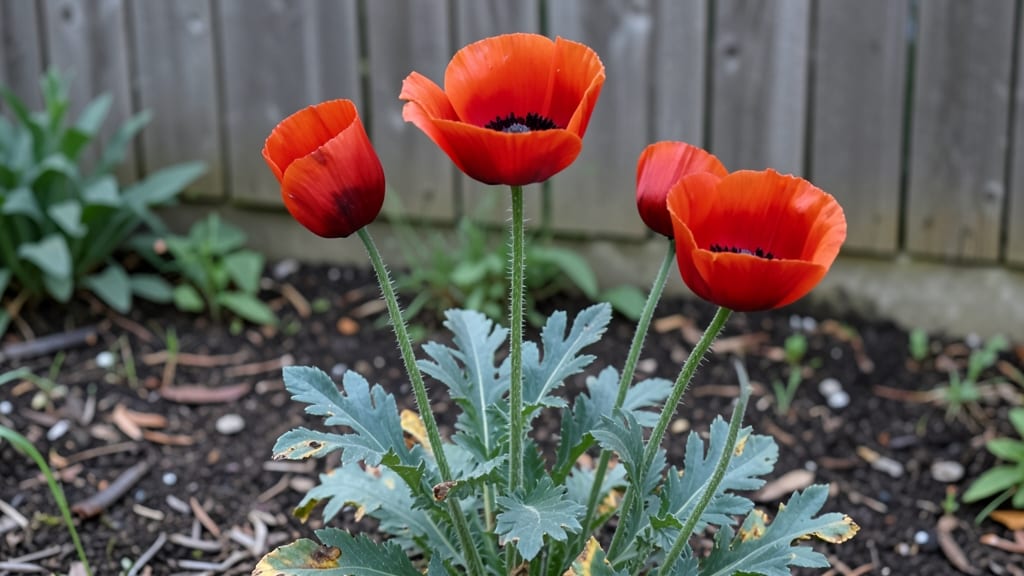
Oriental poppies bloom in late spring to early summer, typically between May and June, producing striking flowers that last 2-3 weeks. Their vibrant petals thrive in cool climates and open fully in sunlight, often closing at night or in rain.
Timing isn’t the only factor—your location plays a huge role. In cooler regions like the Pacific Northwest, these poppies often burst into color as early as April, while in warmer southern climates, they may wait until June or July to show off their bold petals.
I’ve noticed they’re most reliable when planted in well-drained soil with minimal competition, since they dislike soggy roots or heavy fertilization. 🌸
Their short-lived blooms—just 2-3 weeks—make every petal count, so I always recommend deadheading spent flowers to encourage a second, smaller flush. Pairing them with drought-tolerant companions like lavender or catmint creates the perfect low-maintenance garden display, where their striking colors steal the show without demanding constant attention.
💡 In This Article
- Factors Influencing Oriental Poppy Bloom Times
- Planting and Care Tips for Longer Oriental Poppy Blooms
Factors influencing oriental poppy bloom times
Here's what's actually happening with those vibrant blooms: Oriental poppies are cool-season plants that rely on temperature cues to trigger flowering. Their buds form in response to fall temperature drops (typically below 60°F at night) and require a period of dormancy to break.
This is why they often bloom earlier in cooler climates like the Pacific Northwest (April-May) compared to warmer regions where they wait until June or July. The key factor is their vernalization requirement—a cold period that signals it's time to flower, similar to how some bulbs need winter chilling.
Sunlight exposure plays a critical role too. These poppies demand full sun (6-8 hours daily), but here's the catch: they actually close their petals in direct midday heat (above 85°F) to conserve moisture.
In Southern climates, this causes delayed blooming until evening temperatures drop.
The Pacific Northwest's mild summers (average highs of 75°F) create ideal conditions for continuous daytime blooming. 🌞 What most people don't realize is that these flowers have built-in thermoregulation—their petals open when temperatures are 55-75°F and close when it gets too hot or humid, which explains why they often shut at night regardless of climate.
Soil conditions create another layer of variation. Oriental poppies prefer well-drained, slightly alkaline soil (pH 7.0-8.0)—too much organic matter or nitrogen-rich fertilizer actually delays flowering by encouraging leafy growth instead of buds.
In heavy clay soils (common in the Midwest), blooms may be stunted or never appear because the roots suffocate.
The secret is their drought tolerance: once established, they thrive with minimal watering, which is why they bloom best in regions with moderate rainfall (12-18 inches annually) like the Pacific Northwest versus drought-prone areas where they may wait for seasonal rains.
Regional variations show dramatic differences. In Zone 5-6 (Pacific Northwest, New England), blooms appear 4-6 weeks earlier than in Zone 7-8 (Southern California, Texas) due to temperature differences. For example, Seattle's average bloom date is mid-May while Los Angeles typically sees them in late June.
The science involves day-length sensitivity: these poppies are long-day plants that respond to increasing daylight hours, but their exact timing depends on how quickly spring temperatures rise. A sudden heatwave can shock the plant into early budding, while a cool April may delay blooms until May.
Temperature fluctuations create another critical factor. These poppies need consistent temperature swings—warm days (70-75°F) followed by cool nights (50-55°F) to produce the best blooms. In regions with extreme temperature swings (like the Midwest), blooms may be more sporadic.
The ideal scenario is what you find in Mediterranean climates, where mild winters and warm (but not scorching) summers create perfect conditions. This explains why they thrive in coastal areas where ocean breezes moderate temperatures. 🌸
One surprising detail is how humidity affects petal longevity. High humidity (above 70%) causes petals to wilt faster, which is why Southern blooms often last only 5-7 days compared to 10-14 days in drier Pacific Northwest climates.
The difference comes down to how quickly moisture evaporates from the petal surfaces—lower humidity means longer-lasting blooms. This is why gardeners in humid zones often see more closed buds and shorter display periods.