
Blooming
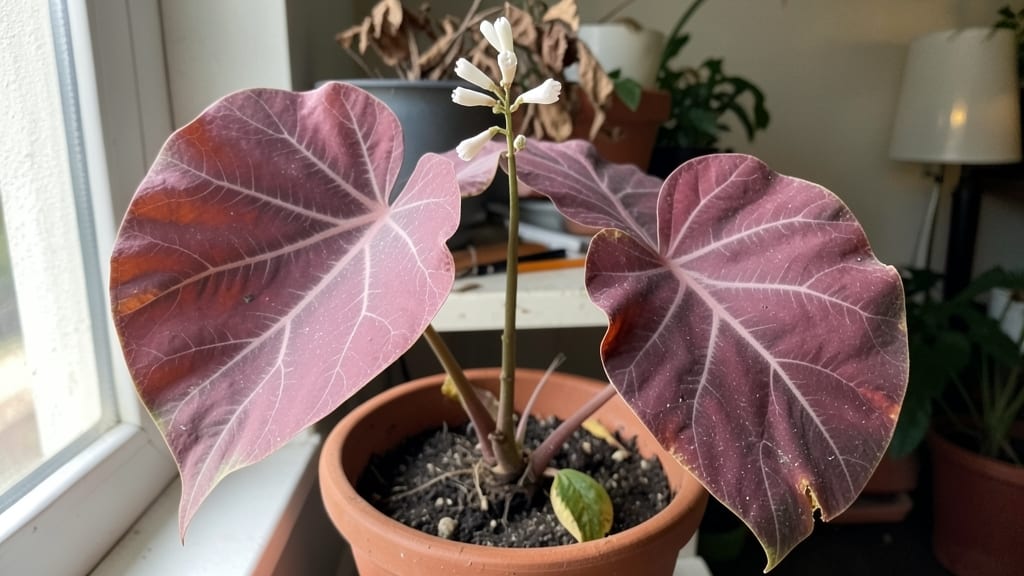
Caladiums rarely bloom because their vibrant foliage is their primary attraction, though they can produce small, subtle flowers under ideal conditions like bright indirect light, consistent warmth, and proper humidity. Flowers are more common in mature plants with well-balanced care.
Caladiums focus their energy on producing those stunning, heart-shaped leaves because that’s what nature selected them to do—think of them as the showstoppers of the shade garden. 🌿 Unlike their flowering counterparts, like impatiens or fuchsias, caladiums evolved in humid tropical forests where sunlight was scarce, so their survival strategy became all about leafy drama rather than flashy blooms.
Even when they do flower, those tiny white or pink blossoms are often overshadowed by the foliage’s vibrant patterns, which is why most growers prioritize leaf quality over bloom potential.
That said, if you’re determined to coax flowers from your caladiums, you’ll need to mimic their natural environment as closely as possible—bright but indirect light, like an east-facing window, and a humidity level that’d make a rainforest jealous.
I’ve found that a light hand with fertilizer (think phosphorus over nitrogen) and a winter dormancy period can actually boost flowering potential the following season. It’s like giving your plant permission to finally show off its hidden talents!
💡 In This Article
- Why Caladiums Prioritize Leaves Over Flowers
- How to Encourage Caladium Flowers Indoors and Outdoors
Why caladiums prioritize leaves over flowers
Caladiums evolved in the dense, humid understories of South American rainforests where sunlight was limited and competition for resources fierce. Nature shaped them to prioritize leaf production over flowers because their stunning heart-shaped foliage—with colors ranging from deep burgundy to neon pink—served as their primary survival advantage.
Unlike flowering plants like peace lilies (which bloom reliably under stress) or philodendrons (which produce occasional aerial blooms), caladiums allocate up to 80% of their energy toward creating larger, more vibrant leaves that outcompete other plants for light in shaded environments.
The key mechanism is hormonal: caladiums produce higher levels of auxin (a growth hormone) in their leaves, which suppresses flowering signals.
This is similar to how corn plants prioritize ear development over tassels when nitrogen is abundant. 🌱 In their native habitat, flowering would be energetically wasteful—tiny white or pink blooms offer little reproductive benefit compared to the leafy canopy they create.
Even when they do flower, those blossoms are often short-lived (lasting just 2-3 days) and lack the showy appeal of their foliage.
Here's where it gets interesting: caladiums share this leaf-focused strategy with other tropical shade plants, but with a crucial difference. While peace lilies (Spathiphyllum) and philodendrons will occasionally produce flowers as a stress response, caladiums only bloom when they've reached maturity (2-3 years old) and are given perfect conditions.
This makes them more finicky than their flowering counterparts—like a diva who only sings encores when the stage lighting is just right.
The role of dormancy is critical too. Unlike many houseplants that flower year-round, caladiums need a 4-6 week rest period in cool (60-65°F) conditions to reset their energy reserves. During this time, they're not just "sleeping"—they're actively preparing for next season's leaf production.
Skipping dormancy is like skipping a chef's prep work: you might get a mediocre dish, but no Michelin-star blooms.
What most growers don't realize is that caladium flowers serve a secondary purpose: they're actually insect-attracting bait for pollinators in their native habitat. The tiny blooms produce minimal nectar but contain pollen that helps maintain genetic diversity.
In our gardens, these flowers are often overlooked because they're 1-2 inches wide and lack the vibrant colors of their foliage—like a jazz musician in a rock band, they're there but not the main attraction.
Interestingly, some caladium varieties (like 'White Queen' or 'Candidum') are more likely to flower than others because they've been selectively bred for this trait. These cultivars have slightly different hormonal balances that make them more willing to "split their focus" between leaves and flowers.
It's like comparing a marathon runner (foliage-focused) to a sprinter (flower-focused)—both are amazing, but they're built for different races. ✨