
Blooming
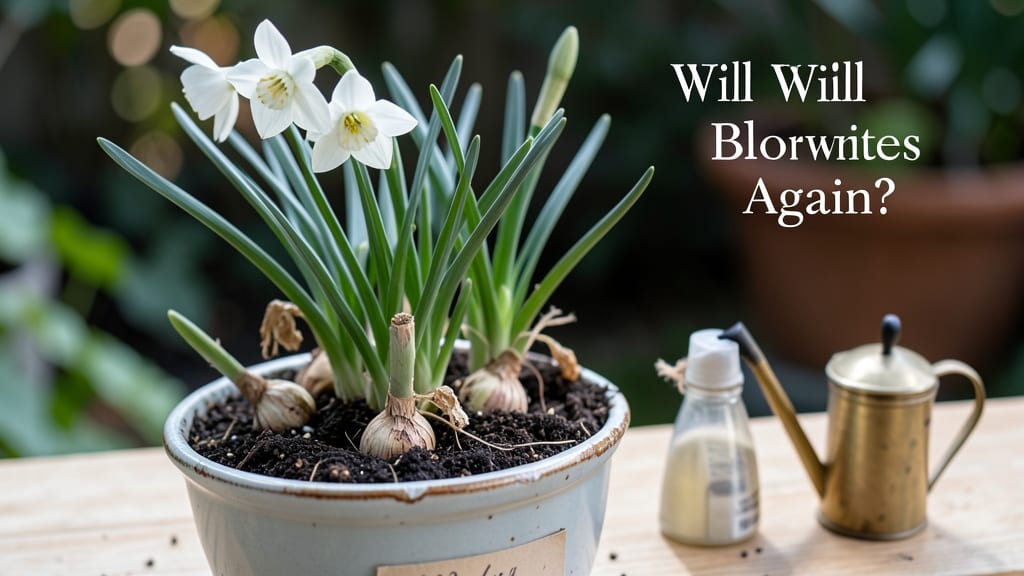
Paperwhites will typically not bloom again after their first flowering cycle since they're forced bulbs engineered for one-season displays. However, with ideal conditions and careful maintenance, some may produce smaller blooms in future years.
Paperwhites are special because they're grown through a process called forcing, which pushes them to bloom quickly indoors. 🌱 This rapid growth depletes their energy reserves, leaving little strength for another flowering cycle.
While most won't rebloom, those that do usually show smaller flowers after proper post-bloom care, including adequate light and balanced fertilization during their dormant period.
What makes this interesting is how their care after blooming can influence future potential. Unlike perennial bulbs like daffodils, paperwhites don't naturally store enough energy for reblooming. The key is giving them the right conditions to recover—think of it like helping a plant "save up" for next season's growth.
For those who want to try, the secret lies in post-bloom maintenance: reducing water slightly, providing bright indirect light, and avoiding fertilizer until new growth appears. This approach gives the bulb a fighting chance to rebuild its energy stores for potential future blooms.
💡 In This Article
- Why Paperwhites Rarely Rebloom: Biological and Growth Factors
- Maximizing Paperwhite Longevity: Care Tips for Future Growth
Why paperwhites rarely rebloom: biological and growth factors
Paperwhites are forced bulbs, meaning they undergo a controlled process to bloom quickly indoors. This rapid growth depletes their stored energy reserves—typically 50-70%—which are primarily carbohydrates and nutrients stored in the bulb during its natural growth cycle.
Unlike perennial bulbs like daffodils, which store excess energy for multiple blooming seasons, paperwhites are bred to prioritize a single, dramatic display over longevity. 🌱 The forcing process itself accelerates metabolic activity, leaving little energy for future blooms.
The root system plays a critical role in this limitation. Paperwhites develop a shallow, fibrous root network during their initial growth phase, which isn't designed for long-term nutrient absorption. In contrast, reblooming bulbs like tulips or daffodils develop deeper, more robust root systems that can sustain multiple flowering cycles.
The shallow roots of paperwhites also make them more sensitive to overwatering, which can further stress the bulb and reduce its ability to recover energy stores for reblooming.
Light exposure after blooming is another key factor. Paperwhites require bright, indirect light (like a south-facing window) to photosynthesize and rebuild energy reserves. Without adequate light, the bulb enters a weakened dormant state, making reblooming nearly impossible.
Even with ideal light, the bulb must also receive 6-8 weeks of consistent care post-bloom to have any chance of storing enough energy for future growth. This is why most paperwhites are treated as disposable—their energy is entirely focused on that first, stunning display.
Temperature fluctuations also impact reblooming potential. Paperwhites thrive in 65-75°F during growth but need a cooler 50-60°F period after blooming to simulate natural dormancy. Without this cooling phase, the bulb remains in an active growth state, continuously burning energy without replenishing it.
This is a common misstep—many gardeners keep paperwhites in warm conditions year-round, unintentionally accelerating energy depletion and reducing any chance of reblooming.
For comparison, consider daffodils, which can rebloom because they store energy in both the bulb and their extensive root systems. Daffodils also have a more flexible metabolic rate, allowing them to adapt to varying conditions.
Paperwhites, however, are genetically optimized for a single, showy bloom rather than longevity. Their entire life cycle is compressed into 6-8 weeks of forced growth, leaving little room for recovery. 💫
What most people don't realize is that even with perfect care, reblooming paperwhites will rarely produce flowers as large or abundant as their first cycle. Any subsequent blooms are typically smaller and may take 1-2 years to appear, if at all.
This is because the bulb's energy reserves are permanently reduced after the initial forcing process, making each potential rebloom a delicate balancing act between recovery and exhaustion.