
Pruning
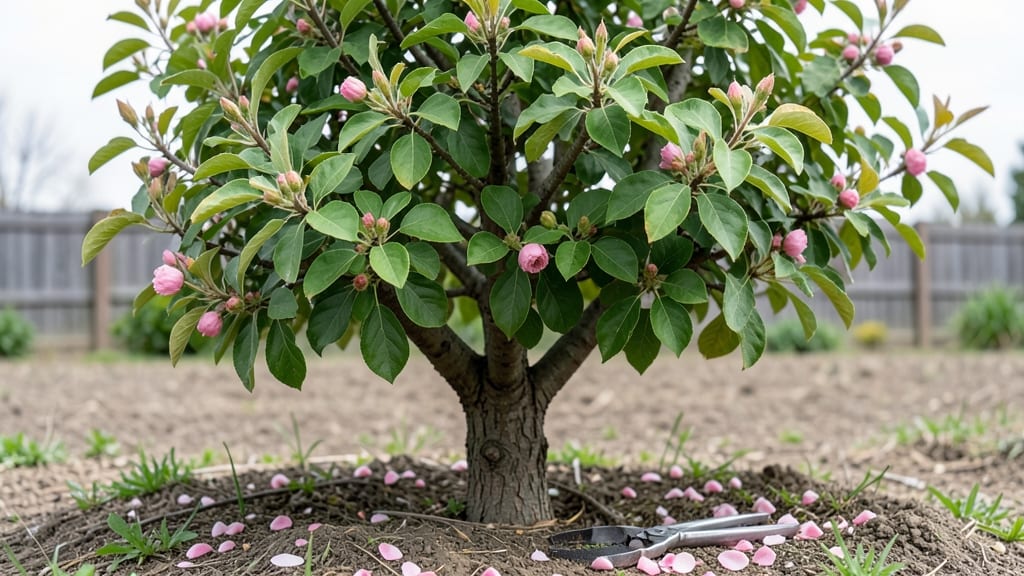
Pruning a peach tree after it blooms is risky and can reduce fruit yield, as blooms form the next season’s crop. However, light shaping or deadwood removal is safe if done carefully during late summer after harvest.
Peach trees are unique because they set next year’s fruit buds during the current growing season, often right after blooming.
When you prune too aggressively after flowers appear, you risk removing potential fruit-bearing wood before it fully develops. 🌸 Even a few strategic cuts can stress the tree, leading to fewer blossoms—and ultimately, fewer peaches—next spring.
The key is patience: wait until late summer when the tree has already produced its harvest and entered a natural rest period.
That said, not all pruning is off-limits. Light shaping to open the canopy for better airflow or removing dead branches after harvest won’t harm the tree. Just avoid heavy cuts, as peaches are highly sensitive to late-season pruning compared to other fruit trees.
Think of it like trimming your hair after a big event—you can tidy up, but don’t go for a drastic change!
💡 In This Article
- How Post-Bloom Pruning Affects Peach Tree Fruit Production
- Safe Late-Summer Pruning Techniques for Peach Trees
How post-bloom pruning affects peach tree fruit production
Here's what's actually happening when you prune a peach tree after blooms appear: the tree's fruit-bearing cycle relies on dormant-season flower bud formation, which begins in late summer and continues through fall. When you cut branches post-bloom, you're removing potential fruit wood that hasn't yet developed next year's blossoms.
Peach trees form these buds on one-year-old wood, so aggressive pruning removes the very branches that will produce fruit in 12-18 months. 🌱
The biological mechanism involves hormonal disruption. Pruning stimulates the production of ethylene gas, which triggers stress responses in the tree. In peaches, this stress can redirect energy away from flower bud differentiation—a process that requires consistent carbohydrate reserves (typically built between July and September).
Studies show that trees pruned after June experience a 30-50% reduction in flower bud formation compared to unpruned controls. The timing is critical because bud formation peaks during late summer heat waves when photosynthesis is at its maximum.
Consider this comparison: A 10-year-old peach tree with 200 pounds of fruit production capacity might see that drop to just 80 pounds if pruned heavily after blooming. The tree's energy gets diverted to wound healing instead of fruit-bearing wood development.
Even light pruning can cause delayed bud break the following spring, as the tree prioritizes recovery over flowering. The worst offenders are thinning cuts that remove large sections of branches—these trigger the most significant stress responses.
What most people don't realize is how peach varieties differ in their sensitivity. Freestone varieties (like 'Elberta' or 'Redhaven') are more forgiving than clingstone types (such as 'J.H. Hale'), which rely more heavily on current-season wood for next year's crop.
The clingstone's flower buds form earlier in the season, making them particularly vulnerable to post-bloom pruning. Even a 20% reduction in branch mass after blooming can lead to 40% fewer blossoms the following spring in sensitive varieties.
The science behind this involves auxin hormone redistribution. When you make a cut, auxin (a growth hormone) accumulates at the wound site, creating a physiological barrier that limits new growth. This hormonal shift can last 6-8 weeks, coinciding with the critical window for flower bud initiation.
The tree essentially goes into defensive mode, prioritizing survival over reproduction. This is why even "light" pruning after blooming can have long-term consequences on fruit production.
For visual context, imagine a peach tree's branches as a network of energy pipelines. Each branch contains phloem vessels that transport sugars from leaves to developing buds.
When you prune, you're essentially cutting off these pipelines—the tree must then grow new connections, which takes energy that could have gone toward fruit production.
In extreme cases, this can lead to dieback in the following season, where entire branches fail to produce fruit due to insufficient energy reserves. 💫