
Blooming
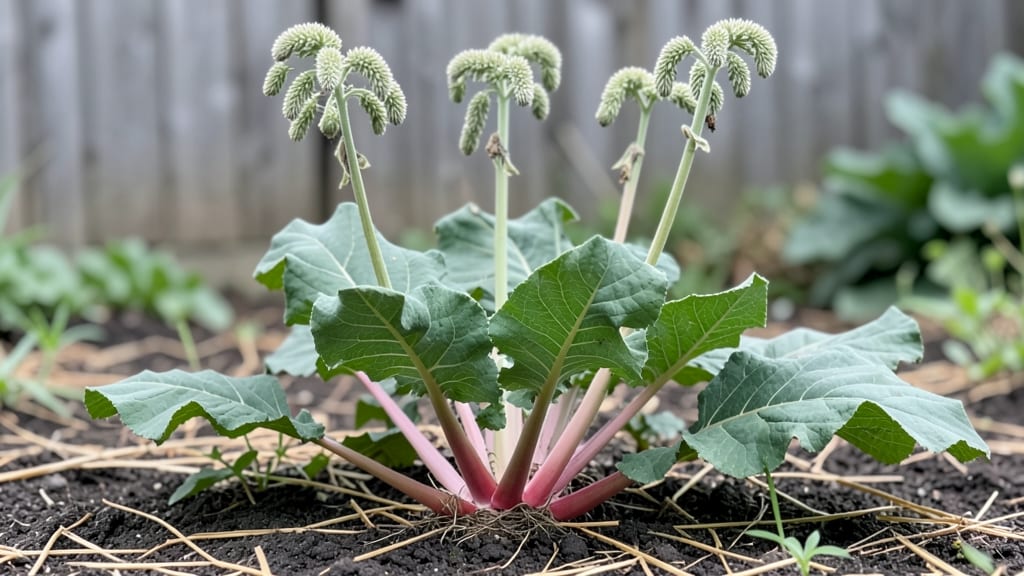
Rhubarb does bloom, producing tall, pinkish-green flower stalks in late spring, though gardeners often remove them to prioritize leaf harvest. These flowers signal the plant’s maturity but can divert energy from growth if left unchecked. Blooms appear after 2-3 years of establishment, typically in May or June depending on climate.
Those striking pinkish-green blossoms aren't just decorative—they're nature's way of telling you the plant is ready to reproduce. 🌸 The rhubarb's crown diverts energy toward flower production once it reaches 2-3 years of age, which can reduce your leaf harvest if left unchecked.
I've found that removing flower stalks early (before they open) preserves more energy for those prized tart stalks, especially in cooler climates where growth seasons are shorter.
Interestingly, rhubarb flowers follow a biennial pattern—meaning they often bloom heavily one year, then focus on leaf growth the next. This cycle explains why some gardeners see dramatic shifts in yield from year to year.
The key is balancing flower removal with the plant's natural rhythms to keep your harvest consistent.
💡 In This Article
- Rhubarb Flowering Cycle: Stages and Biological Purpose
- Managing Rhubarb Flowers for Optimal Leaf Yield
Rhubarb flowering cycle: stages and biological purpose
The rhubarb's flowering cycle begins in its crown, where dormant buds—formed during the previous growing season—awaken in response to increasing daylight and temperatures. These buds, located just below the soil surface, contain the genetic blueprint for both leaves and flowers, but the plant's energy allocation shifts dramatically as it matures.
Here's what's actually happening: once rhubarb reaches 2-3 years of age, its crown prioritizes reproductive growth over leaf production, diverting up to 40% of its photosynthetic energy toward flower development. 🌱 This biological trade-off explains why younger plants rarely bloom—they're still building root systems and leaf mass.
The flowering process is triggered by a combination of temperature thresholds and daylength sensitivity. Rhubarb is a long-day plant, meaning it requires 14-16 hours of daylight to initiate blooming—a condition typically met in late April to May in temperate zones.
The plant's crown detects these longer days through phytochrome pigments, which signal it's time to reproduce. Interestingly, rhubarb flowers develop from axillary buds (located in leaf axils) rather than terminal buds, which is why multiple flower stalks can emerge from a single plant.
Each stalk can grow 3-5 feet tall and produces clusters of 10-20 flowers, each with five petals ranging from pale pink to greenish hues.
What most people don't realize is that rhubarb's flowering pattern follows a biennial rhythm rather than annual. This means the plant often produces heavy blooms one year, then focuses entirely on leaf growth the next—a cycle influenced by carbohydrate reserves in the crown.
The energy cost of flowering can reduce leaf yield by 20-30% in the blooming year, which is why gardeners in cooler climates (USDA zones 3-6) see more consistent harvests when they manage flowers carefully.
The plant's native habitat in Siberia and Mongolia also explains why it's adapted to these alternating patterns—nature's way of balancing reproduction with survival in unpredictable climates. 🌿
Here's how the flowering stages break down: first appear the flower buds (typically in late April), followed by stem elongation (May), then full bloom (May-June). After pollination, the flowers develop into seed pods that contain 100-200 tiny seeds per pod—though these rarely germinate successfully in garden settings.
The entire cycle from bud to seed takes about 6-8 weeks, during which the plant's root system continues growing but at a reduced rate compared to non-flowering years.
Temperature plays a critical role in determining bloom timing. In warmer climates (zones 7-9), rhubarb may bloom as early as March, while in colder regions (zones 2-4), flowers often appear in June.
The plant requires chilling hours (below 40°F) during winter to properly initiate flowering the following spring—a process called vernalization. Without adequate chilling, rhubarb may produce fewer or weaker flower stalks.
This biological mechanism explains why newly planted rhubarb often takes 2-3 years to bloom—it needs to build sufficient root reserves and complete its chilling requirements first. 🌡️
The plant's energy allocation becomes particularly visible when comparing biennial vs perennial growth patterns. In its first year, rhubarb focuses entirely on establishing roots and a small crown. By year two, it produces leaves and may begin flowering lightly.
In year three and beyond, the plant enters its productive flowering phase, where it alternates between heavy blooming and leaf-focused years. This cycle is why some gardeners report dramatic yield fluctuations—what appears to be poor growth may simply be the plant's natural reproductive rhythm at work.
Understanding this cycle helps explain why rhubarb flowers are often removed: each flower stalk represents energy diverted from leaf production. The plant's crown must decide whether to invest in reproduction or continued growth—a decision influenced by its age, health, and environmental conditions.
For gardeners, this means timing is everything: removing flower stalks early (before they open) preserves more energy for those prized tart stalks we all love. 💫